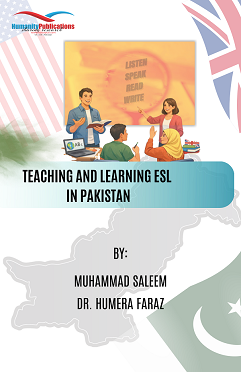
Teaching and Learning ESL in Pakistan

  • Author

    Muhammad Saleem, PhD Scholar, Khyber Pakhtunkhwa,
    Dr Humera Faraz, Assistant Professor, Department of English, Air University, Islamabad, Pakistan
  • Author's Email

    muhammad.saleem@gmail.com or books@humapub.com
    Monday to Friday 9am - 7pm
  • Publisher Contact

    info@humapub.com - +92-332-914-7618
    Monday to Sunday 24 Hours
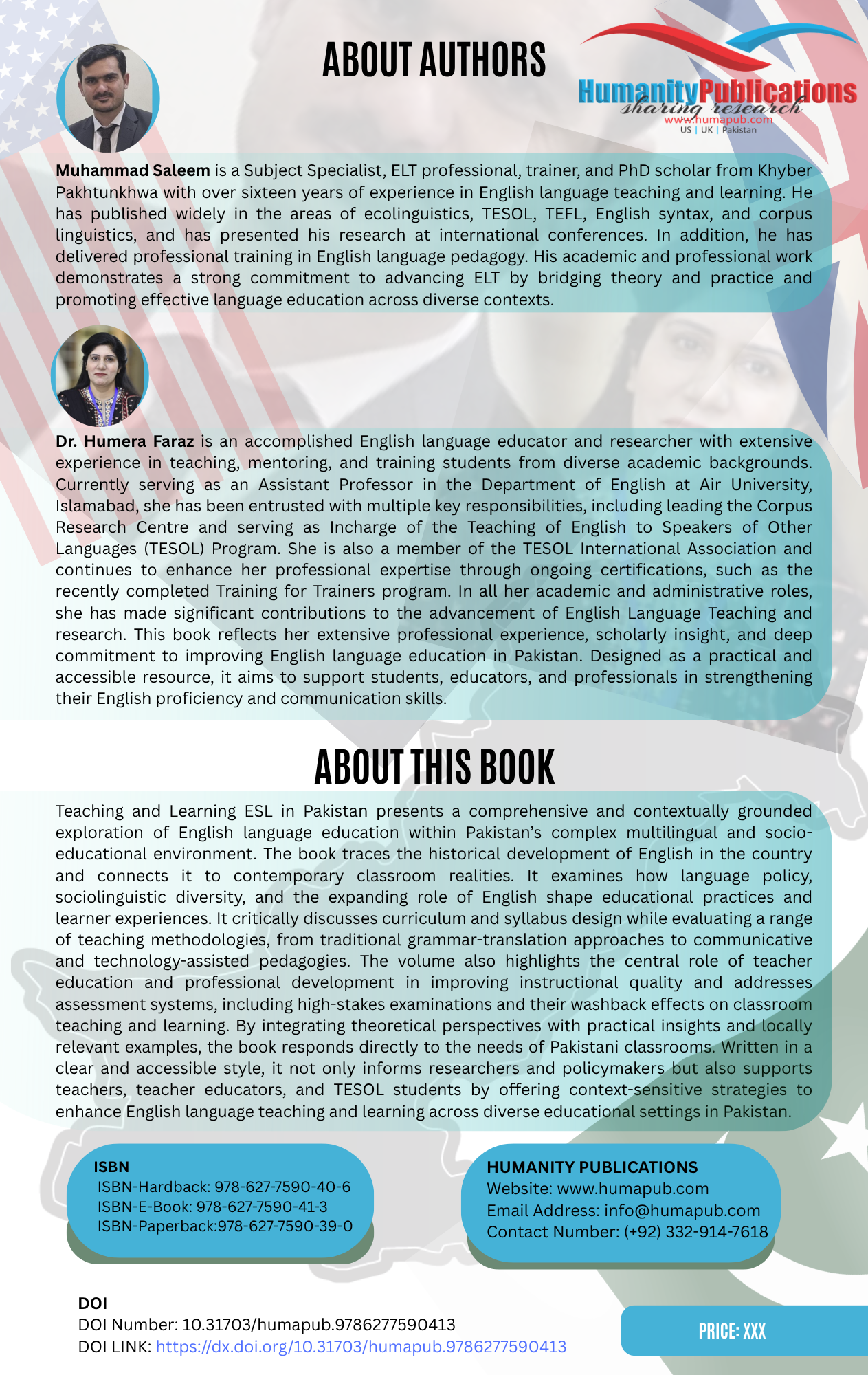
About authors Muhammad Saleem is a Subject Specialist, ELT professional, trainer, and PhD scholar from Khyber Pakhtunkhwa with over sixteen years of experience in English language teaching and learning. He has authored several research papers in the field of English syntax, ELT, corpus linguistics, and Ecolinguistics, presented at international conferences, and provided professional training in English language pedagogy. His academic and professional contributions reflect a strong commitment to advancing the field of ELT by integrating theory with practice and supporting effective language education in diverse contexts. Dr. Humera Faraz  is an accomplished English language educator and researcher with extensive experience in teaching, mentoring, and training students from diverse academic backgrounds. Currently serving as an Assistant Professor in the Department of English at Air University, Islamabad, she has been entrusted with multiple key responsibilities, including leading the Corpus Research Centre and serving as Incharge of the Teaching of English to Speakers of Other Languages (TESOL) Program. Dr. Faraz is also a member of the TESOL International Association and continues to enhance her professional expertise through ongoing certifications, such as the recently completed Training for Trainers program. In all her academic and administrative roles, she has made significant contributions to the advancement of English Language Teaching and research. This book reflects her extensive professional experience, scholarly insight, and deep commitment to improving English language education in Pakistan. Designed as a practical and accessible resource, it aims to support students, educators, and professionals in strengthening their English proficiency and communication skills. 

Teaching and Learning ESL in Pakistan is an engaging and thoughtful book that addresses one of the most pressing issues in our education system. It does not simply describe the challenges of English language learning but also connects them to the wider realities of schools, teachers, and students across the country. The book is written in a clear and approachable way. It is useful not only for researchers and policymakers but also for teachers who deal with these challenges every day. This book captures the Pakistani context and brings forward examples, realities, and voices that are truly our own. It encourages reflection, discussion, and hopefully action to improve how English is taught and learned in Pakistan. 

Table of Contents
Preface

    English as a Second Language (ESL) holds a central position in Pakistan’s educational, social, and professional spheres. Since the country’s inception, English has functioned not merely as a foreign language but as a gateway to higher education, global communication, and socioeconomic mobility. Over the decades, its role has evolved shaped by historical legacies, political decisions, and the growing demands of globalization. Yet, English language education in Pakistan remains fraught with challenges, including policy inconsistencies, unequal access, and disparities between rural and urban learning environments. The book Teaching and Learning ESL in Pakistan presents a comprehensive exploration of these issues, aiming to provide a balanced perspective on the development, implementation, and outcomes of English language education across the country. The primary purpose of this book is to offer educators, researchers, policymakers, and teacher trainers a thorough understanding of ESL teaching and learning within the Pakistani context. It not only reviews historical and theoretical perspectives but also integrates practical insights drawn from the realities of classrooms, schools, and teacher training institutions. By combining academic rigor with contextual understanding, the book seeks to bridge the gap between linguistic theory and pedagogical practice, offering valuable lessons for sustainable and equitable English language education. The opening chapter introduces readers to the historical background of English in Pakistan and traces its evolving role in education, governance, and society. It outlines how colonial legacies have shaped linguistic hierarchies and how, over time, English has become both a symbol of modernity and a marker of social status. Chapter Two focuses on national language policy and planning, unpacking the complex relationship between English, Urdu, and regional languages. It further examines the long-standing debates over the medium of instruction and the differential impact of policy decisions on urban and rural schooling. Chapter Three turns to the sociolinguistic dimensions of English in Pakistan. It explores the country’s rich multilingual context, attitudes toward English and Urdu, and how regional languages intersect with identity and power. These discussions highlight the deep connection between language and social mobility, revealing how English continues to shape aspirations and opportunities. Chapter Four centers on the learners themselves, examining their demographics, learning needs, and the disparities in access between urban and rural students. Gender-based differences in learning environments and opportunities are also discussed to emphasize the broader issue of inclusion and equality in language education. Curriculum and syllabus design are examined in Chapter Five, which reviews Pakistan’s national curriculum framework for English, evaluates textbooks, and questions the cultural relevance of teaching materials. The analysis underscores the necessity of developing culturally responsive ESL content that aligns with local contexts while maintaining international standards. Chapter Six moves into teaching methods and approaches, tracing the persistence of the grammar–translation method and exploring the gradual shift toward communicative language teaching (CLT) and technology-enhanced learning. This chapter encourages reflection on how global pedagogical models can be adapted to Pakistan’s unique educational settings. Chapter Seven highlights teacher education and professional development. It discusses the qualifications, training, and ongoing professional growth of ESL teachers in Pakistan, as well as the challenges faced by teacher training colleges and universities. The chapter emphasizes that the success of any ESL program ultimately depends on the preparedness, motivation, and continuous development of teachers. Chapter Eight examines assessment and evaluation practices, focusing on high-stakes examinations such as board exams and O/A Levels. It critiques the washback effects of these assessments and introduces alternative evaluation methods that promote communicative and functional language skills. The concluding Chapter Nine addresses the overarching challenges of ESL education in Pakistan ranging from infrastructural deficiencies and resource limitations to socioeconomic and gender disparities. It draws attention to systemic inequities that hinder effective language learning and calls for reforms rooted in inclusivity, innovation, and practicality. The chapter advocates for a reimagined ESL framework that not only meets academic objectives but also nurtures learners’ confidence, creativity, and critical thinking. The contributors have put forth their utmost efforts in developing this book. Each has drawn upon extensive experience in English language teaching, research, and training to ensure that the content is both scholarly and practically grounded. Their collaboration reflects a shared commitment to improving ESL education in Pakistan by integrating pedagogical insight with contextual sensitivity. The book represents a collective vision to support teachers, inspire learners, and guide policymakers toward more effective English language teaching practices. Ultimately, Teaching and Learning ESL in Pakistan aspires to spark reflection and reform in how English is taught and learned across the country. It invites readers to look beyond traditional classroom practices and consider language as a living force that connects people, cultures, and ideas. By fostering dialogue between educators and decision-makers, this book aims to contribute to a more inclusive, equitable, and forward-looking model of English education in Pakistan one that empowers every learner to engage confidently with both national and global communities.

Foreword
  • It gives me immense satisfaction to write the foreword for this work. The book before you is a significant scholarly contribution to the field of English as a Second Language (ESL) in Pakistan. The text provides a nuanced analysis of historical legacies, language policy, curriculum frameworks, teaching methodologies, assessment practices, and the lived realities of teachers and learners. It situates English within the broader sociolinguistic context of Pakistan which draws attention to the tensions between English, Urdu, and regional languages, as well as the socioeconomic and gender disparities that shape access to learning opportunities. What I particularly appreciate about this work is its balance between critical analysis and constructive vision. The authors do not merely highlight challenges such as resource gaps, large class sizes, and policy ambiguities but also points toward practical reforms and pedagogical strategies that can improve ESL education in the country. This book will, I believe, serve as a valuable reference for those who wish to understand and improve the teaching and learning of English in Pakistan. It will also inspire students of education to engage in meaningful research that bridges theory and practice, and that responds to the real needs of our classrooms and communities. It is my hope that this book will reach a wide readership and contribute to shaping more inclusive and effective English language education in Pakistan.

Acknowledgement
    The completion of Teaching and Learning ESL in Pakistan would not have been possible without the support, encouragement, and contributions of many individuals and institutions. We express our sincere gratitude to all those who, directly or indirectly, assisted us throughout the development of this book. First and foremost, we are deeply thankful to our students, colleagues, and fellow educators whose experiences, insights, and dedication to English language teaching inspired many of the ideas presented in this work. Their daily engagement with the challenges and opportunities of ESL education in Pakistan provided valuable perspectives that enriched our understanding of the field. We extend our appreciation to researchers and scholars whose studies have contributed significantly to the body of knowledge on language education, multilingualism, curriculum development, and language policy. Their scholarly work has served as an important foundation for the discussions and analyses presented in this book. We are particularly grateful to the teachers working in schools, colleges, and universities across Pakistan. Despite numerous challenges, they continue to strive for excellence in language education and play a vital role in shaping the academic and professional futures of their students. Their commitment remains a source of inspiration and hope for educational progress in the country. We also acknowledge the contributions of policymakers, curriculum developers, and teacher educators whose efforts continue to influence the direction of English language teaching and learning in Pakistan. Their work highlights the importance of creating equitable and effective educational opportunities for learners from diverse backgrounds. Special thanks are due to our families for their unwavering support, patience, and encouragement throughout the writing process. Their understanding and belief in the value of this project provided the motivation needed to bring it to completion. Finally, we would like to thank Humanity Publications for providing a platform for the dissemination of scholarly work and for supporting initiatives that promote academic excellence and educational development. It is our sincere hope that this book will contribute to ongoing discussions about English language education in Pakistan and serve as a useful resource for teachers, researchers, students, and policymakers working toward a more inclusive, effective, and learner-centered ESL environment.
Copyrights
  • No part of this book may be reproduced, utilized, stored, or transmitted in any form or by any means, electrical or mechanical, including photocopying, recording, or any information, storage, or retrieval system without prior written permission from Humanity Publications.
Disclaimer

    The contents of this book solely reflect the author’s viewpoints and are not indicative of any organizational stance. Information presented within this publication has been gathered by the publisher from sources deemed reliable. Nevertheless, given the potential for human or mechanical errors from various sources, including the publisher, absolute accuracy, adequacy, or completeness of the information cannot be guaranteed. Consequently, the publisher disclaims responsibility for any errors, omissions, or outcomes resulting from the utilization of said information.


Analysis of MPhil/PhD Supervisor's Relationship Development and Communication Competence , , ,
Abstract:

The purpose of this research was to analyse the relationship development and communication competence of MPhil/PhD supervisors. A confirmatory mixed-methods research design was used to conduct the study in two stages. For both phases, 360 MPhil/PhD graduates and 72 supervisors were selected from four public universities in Punjab using a multistage sampling technique. Data were collected electr... read more PDF     Full Text     Views (19405)

Shah Waliullah and his Concept of Welfare State: An Analysis , , ,
Abstract:

Muslim scholars have contributed enormously to the concept of welfare State. Among them Shah Waliullah is the rising sun who was born in South Asian sub-continent in the 19th century. He was holding the firsthand knowledge of Quran and Hadiths, the first primary sources in Islam. Shah Waliullah's point of view regarding welfare state occupies central theme in his works. His basic concepts like ... read more PDF     Full Text     Views (19066)

Political Islam in Perspective , , ,
Abstract:

The paper critically evaluates the notion that political Islam is a threat to world peace. The argument is developed in the light of Islamic history and fundamentals of Islam and the research is based on primary and secondary sources. There was a time when magical influence of Muslims in every field of life (socio-economic, Political scientific) was conspicuous. For instance, Al Farabi's books ... read more PDF     Full Text     Views (11855)

Causes of Teacher's Favoritism and Its Effects on the University Students: A Case Study , , ,
Abstract:

This study aims at exploring and examining the causes of teacher's favoritism and its effects on the university students. Quantitative tools are applied to collect data for the study and to check its reliability. The results of the data reveal that the teachers favor the students on the basis of gender, race, area, similar political ideology and family/blood relation. The study also indicates t... read more PDF     Full Text     Views (10075)

Effect of Self-Regulated Learning Strategies on Eighth Grade Students' Motivation for Learning English , , ,
Abstract:

This was proposed to investigate the effect of self-regulated learning strategies on students’ motivation for learning English. This was an experimental research. Intact group pretest and posttest of design was utilized for data collection. Intact groups (experimental and control) of student studying in eighth class were selected voluntarily. Experimental group was taught with SRL strateg... read more PDF     Full Text     Views (8863)

Manifestation of Gender-Binaries in Pakistani Television Commercials: A Semiotic Analysis , , ,
Abstract:

The current study investigates the prevalent gender-binary narrative in Pakistani television commercials. It tends to portray the dominant gender representational mechanisms which are implicitly employed by the advertisers. Television commercials, having the power to (re)frame the ideology of larger audience through visual/linguistic content and agency to pave the way for social change have bec... read more PDF     Full Text     Views (7768)

An Exploration of Issues and Challenges Faced by Students in Distance Learning Environment , , ,
Abstract:

This paper investigates the issues and challenges encountered by students obtaining distance education in Pakistan. We conducted interviews with students obtaining distance education and they were enrolled in different study programs. Qualitative interviews were conducted to understand the perception of the study participants regarding the issues and challenges faced by them in learning. Studen... read more PDF     Full Text     Views (7292)

Effects of Integrated lessons on Learning Urdu Language Skill of Students at Primary Level , , ,
Abstract:

The study explores the effectiveness of integrated and traditional instruction method in developing reading and writing skills in Urdu language at primary level. As an experimental study it used Pretest, post-test and control group design in finding these effects. The researcher developed integrated instruction model for Urdu language by combining contents of Urdu and Islamic Studies by adoptin... read more PDF     Full Text     Views (6820)

Politics of Identity and Redrawing the State Boundaries in India: An Historical Perspective , , ,
Abstract:

This article will examine the idea of new states/provinces in India. How India created 16 new states on ethno-lingual, and other lines and accommodate the ethnic groups. The case study of India is focussing on the different factors; including constitutional setup and role of different political parties of India in making of the new state. The following three basic questions investigate the pape... read more PDF     Full Text     Views (6707)

Comparative Analysis of the Scholars Perception about Research in Public and Private Universities in Pakistan , , ,
Abstract:

The base of a successful university in providing quality education and practical knowledge for improving the lives of the youths in terms of social, economical and intellectual development are only possible through promoting research culture. Research conduct and writing is the most important tool for identifying remedial recommendations for education and related problems. This research present... read more PDF     Full Text     Views (6441)


Shah Waliullah and his Concept of Welfare State: An Analysis , , ,
Abstract:

Muslim scholars have contributed enormously to the concept of welfare State. Among them Shah Waliullah is the rising sun who was born in South Asian sub-continent in the 19th century. He was holding the firsthand knowledge of Quran and Hadiths, the first primary sources in Islam. Shah Waliullah's point of view regarding welfare state occupies central theme in his works. His basic concepts like ... read more PDF     Full Text     Downloads (157)

Hamlet and Pluralism: A Postmodernist Metaphor , , ,
Abstract:

The present study means to investigate Hamlet in the light of postmodernist-Deconstructive theoretical framework. The play seems to reinforce the overarching dominant patriarchal meta-narrative, with supposed unitary voice and unified identities. The current reading means to show that the play is a metaphor of postmodernism with pluralistic subjectivities, multiple alternative micronarrative vo... read more PDF     Full Text     Downloads (93)

Causes of Teacher's Favoritism and Its Effects on the University Students: A Case Study , , ,
Abstract:

This study aims at exploring and examining the causes of teacher's favoritism and its effects on the university students. Quantitative tools are applied to collect data for the study and to check its reliability. The results of the data reveal that the teachers favor the students on the basis of gender, race, area, similar political ideology and family/blood relation. The study also indicates t... read more PDF     Full Text     Downloads (81)

Effects of Integrated lessons on Learning Urdu Language Skill of Students at Primary Level , , ,
Abstract:

The study explores the effectiveness of integrated and traditional instruction method in developing reading and writing skills in Urdu language at primary level. As an experimental study it used Pretest, post-test and control group design in finding these effects. The researcher developed integrated instruction model for Urdu language by combining contents of Urdu and Islamic Studies by adoptin... read more PDF     Full Text     Downloads (75)

Ideology, (Mis)perceptions and (Re)construction of Political Identities: A Critical Discourse Analysis of Imran Khan's Political Speeches , , ,
Abstract:

This study examines the persuasive strategies of Imran Khan's political discourse. It also highlights the covert ideological practices as they are embedded in his political speeches. The analysis is based on the theoretical perspective of Fairclough and Van Dijk. This study analyses the linguistic elements and contextual facets to find hidden ideologies. The findings suggest Khan use of multipl... read more PDF     Full Text     Downloads (51)

Developing English Speaking Skills: Enforcing Testing Criteria , , ,
Abstract:

Language is product of four skills: reading, writing, listening and speaking. English language learning and examination has been reduced to reading and writing in Pakistan, at the University level. However, English Speaking Skills (ESS) are in high demand in professional life. ESS require testing and grading like English writing skills. This study is based on developing ESS through testing crit... read more PDF     Full Text     Downloads (41)

Servant Leadership and Enhancement of Organizational Performance , , ,
Abstract:

The Servant Leader Model is a theory that advances administration, supports trust, coordinates effort, future-arranges and utilizes moral capacity to engage others, focusing on good ethical practices. This study inspects the faculty of public and private universities in Peshawar for elements of servant leader behavior (wisdom, emotional healing and persuasive mapping) and effect on performance.... read more PDF     Full Text     Downloads (41)

A Comparative Study of the Kashmir Conflict Coverage in Pakistani and Indian Press , , ,
Abstract:

The paper compares the coverage of JNK conflict in the Pakistani and Indian English press. The objective of the study is to figure out the differences in the coverage of Kashmir conflict by the Indian and Pakistani press along with determining the prominence of war or peace frames in the coverage. Content Analysis was carried out of the news stories published on the international and national p... read more PDF     Full Text     Downloads (39)

The Portrayal of Piggy's Mind in Lord of the Flies in the Light of Ghazalian Theory of Soul and Freudian Psychoanalysis , , ,
Abstract:

This study inquires into the intricacies of the human mind, as portrayed through the character of Piggy in William Golding’s Lord of the Flies. For an in depth analysis, the theoretical framework of Ghazali (1058-1111) and Freud (1856-1939) is used. The study has adapted Attride Sterling’s (2001) model of textual data analysis. This analysis, inside the parameters of the selected th... read more PDF     Full Text     Downloads (38)

A Perspective on Saudi Soft Power and Cultural Diplomacy , , ,
Abstract:

This research analyzes the soft power and cultural diplomacy of the Kingdom of Saudi Arabia. Over the years, the Kingdom has been using its cultural diplomacy as an instrument of foreign policy for the promotion of its soft power at regional and global level. The analysis suggest the use of soft power and cultural diplomacy are part of Kingdom’s foreign policy, bringing a wider gesture of... read more PDF     Full Text     Downloads (37)